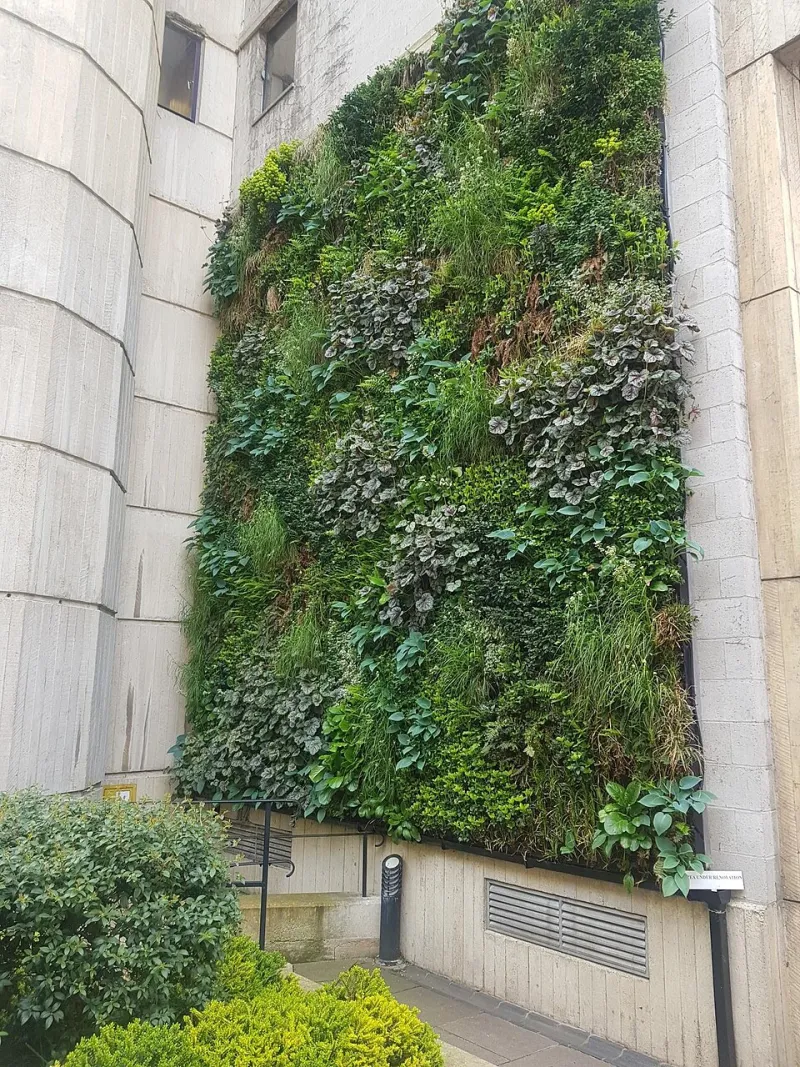
From Aesthetic Feature to Assessed Asset: How Scotland's Property Valuers Are Rethinking Living Walls
Photo: Roger Templeman , CC BY-SA 2.0, via Wikimedia Commons
For much of the past decade, living walls occupied an awkward position in the Scottish property market. Architects celebrated them. Occupiers requested them. Developers commissioned them. Yet when a chartered surveyor arrived to assess a building's worth, those carefully engineered vertical gardens were frequently treated as little more than interior decoration — noted, perhaps, but rarely priced.
That consensus is beginning to fracture. Across Scotland's commercial and residential sectors, a growing cohort of valuers is developing more sophisticated frameworks for assessing the contribution of green architecture to overall property value. The shift is gradual, but its implications are considerable — both for the buildings already adorned with living walls and for the developers deciding whether to invest in them.
Why Valuation Has Lagged Behind Design
The hesitancy of the valuation profession to formally quantify living walls is understandable. Traditional appraisal methodology relies heavily on comparable evidence — sales data, rental transactions, yields — and until recently, Scotland's market lacked a sufficient volume of green-architecture comparables to support confident adjustments.
The Royal Institution of Chartered Surveyors (RICS) guidance on sustainability and valuation has evolved considerably in recent years, with its Sustainability and ESG in Commercial Property Valuation and Strategic Advice guidance note — now adopted by many Scottish practices — explicitly acknowledging that environmental features can influence both market value and investment worth. The challenge lies in translating that acknowledgement into consistent, defensible figures.
For living walls specifically, the complexity is compounded by variation in system quality, plant selection, and maintenance provision. A poorly maintained hydroponic wall with failing irrigation is a liability, not an asset. A well-designed, professionally maintained installation using species suited to Scotland's climate is an entirely different proposition.
The Metrics That Are Beginning to Matter
Several Scottish valuers working in commercial property — particularly in Edinburgh's office market and Glasgow's burgeoning mixed-use developments — report that living walls are increasingly being considered within broader ESG-related assessments. The logic runs as follows: buildings with demonstrable sustainability credentials attract a wider pool of institutional tenants; wider tenant demand supports stronger rental evidence; stronger rental evidence underpins higher capital values.
This is not a hypothetical chain of reasoning. Research published by bodies including the Urban Land Institute and CBRE has pointed to a growing rental premium for buildings with verified green credentials, with some European studies suggesting commercial assets with strong sustainability ratings achieve rents between five and twelve per cent above comparable non-certified buildings. Scotland, as part of the broader UK market, is not immune to these dynamics.
For residential valuers, the calculus is somewhat different. Here, living walls — particularly those installed on private gardens, terraces, or the external elevations of premium city-centre flats — are more likely to be assessed through the lens of kerb appeal, amenity value, and differentiation within the local market. A striking biophilic installation on a New Town tenement or a Merchant City apartment building can meaningfully distinguish a property in a competitive sales environment, even where the precise financial contribution resists easy quantification.
Case Evidence from Scotland's Market
While comprehensive longitudinal data remains limited, anecdotal evidence from Scotland's property sector is increasingly instructive. Commercial agents in Edinburgh have reported that office suites featuring living walls — particularly those visible from client-facing reception areas — are letting more quickly than equivalent units without such features, and in some instances at marginally higher rates. The differentiation is particularly pronounced in buildings where the living wall forms part of a coherent biophilic design strategy rather than existing as a standalone feature.
In the residential sector, a small number of premium developments in Glasgow and Edinburgh have incorporated living walls as part of their amenity offering — shared courtyard installations, rooftop garden walls, and lobby features — and agents marketing these schemes report that the green architecture contributes positively to buyer perception and, in some cases, to the achievable price per square foot relative to nearby schemes without equivalent features.
More significant, perhaps, is the growing recognition among institutional investors that buildings without credible sustainability narratives face increasing obsolescence risk. As the UK government's trajectory on energy performance and environmental standards becomes clearer, assets that can demonstrate genuine environmental credentials — of which living walls form one component — are likely to attract a valuation premium relative to those that cannot.
The Maintenance Question
No serious valuation of a living wall installation can ignore the question of ongoing maintenance. A professionally installed system with a documented maintenance contract and an established relationship with a specialist provider represents a fundamentally different asset from one that has been left to deteriorate. Valuers are increasingly alert to this distinction, and developers commissioning living walls would be wise to ensure that maintenance provision is formalised and evidenced from the outset.
For Scotland specifically, this means selecting plant species with proven resilience to the country's variable climate — the wet winters, the occasional frost, the prolonged periods of low light — and ensuring that irrigation systems are designed with Scottish conditions in mind. A living wall that thrives in a controlled London atrium may struggle on an exposed Edinburgh elevation. Proper specification at the design stage is not merely an aesthetic consideration; it is a prerequisite for the installation retaining its value over time.
A Profession in Transition
The valuation profession in Scotland, as elsewhere in the UK, is in the early stages of developing more robust methodologies for pricing sustainability features. The trajectory is clear: as ESG pressures intensify, as occupier expectations evolve, and as the volume of comparable evidence grows, the case for formally incorporating living walls into property assessments will become increasingly difficult to resist.
For developers, investors, and property owners in Scotland, the message is straightforward. The era in which living walls were treated as decorative luxuries — pleasant to have, impossible to price — is drawing to a close. Those who have invested thoughtfully in quality installations, maintained to a professional standard and integrated into a coherent sustainability strategy, are likely to find that their buildings are better positioned than they may have anticipated.
The green architecture that Scotland's most forward-thinking developers have been commissioning for the past decade is not merely a statement of intent. Increasingly, it is a bankable asset — and Scotland's valuers are beginning to price it accordingly.