Planted for the Long Game: How Scotland's Developers Are Building Living Walls That Outlast the Weather
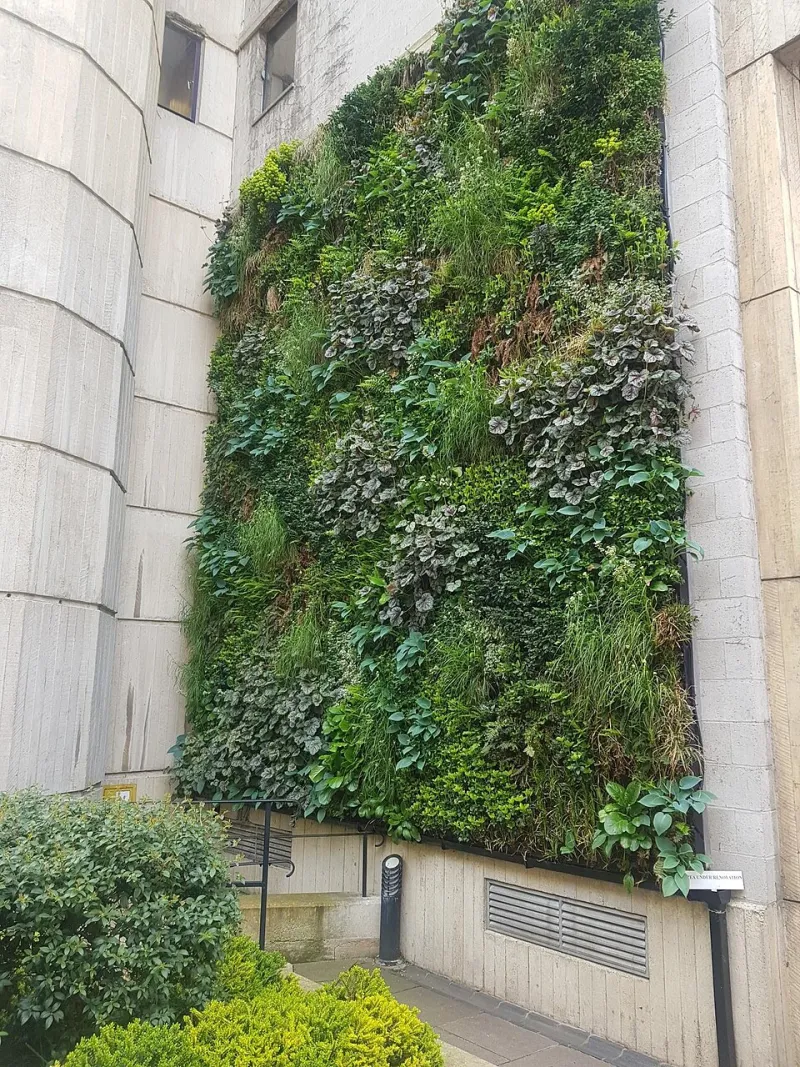
Photo: Harry Princethorpe, CC BY-SA 4.0, via Wikimedia Commons
Scotland has never been a country that takes its weather for granted. Generations of farmers, gardeners, and outdoor enthusiasts have learned to read skies, hedge their bets, and prepare for the unexpected. Yet the climate volatility now emerging across the country — unseasonal frosts arriving in May, extended dry spells in midsummer, and winter storms of unusual ferocity — is presenting a genuinely new set of challenges for those working in green architecture and vertical landscaping.
For developers and architects who have committed to living walls as a core element of their sustainable building strategies, the question is no longer simply whether these installations look impressive or improve air quality. The question, increasingly, is whether they can endure. And if they can, what does that resilience actually require in terms of design, plant selection, and systems infrastructure?
A Shifting Baseline
The Met Office's most recent long-range assessments paint a picture of a Scotland in transition. Warmer, wetter winters are projected to alternate with summers that, whilst still mild by global standards, will increasingly feature periods of low rainfall and elevated temperatures. For living wall installations — systems that depend upon consistent moisture, appropriate root temperatures, and plant species suited to their environment — this shifting baseline demands a fundamental rethink of how designs are specified from the outset.
Traditionally, Scottish living wall projects have drawn upon a relatively narrow palette of robust, moisture-tolerant species: ferns, sedges, heucheras, and various mosses have long been the workhorses of vertical planting schemes north of the border. These remain valuable, but climate-adaptive design is now pushing specifiers towards a broader, more strategically layered approach.
The principle is straightforward: rather than selecting species optimised for average conditions, forward-thinking designers are building plant communities that collectively tolerate the extremes. A wall that combines deep-rooted drought-tolerant specimens alongside moisture-retaining bryophytes and frost-hardy evergreens is far better positioned to absorb climatic shocks than one planted to a single seasonal brief.
The Case for Species Diversity
Plant selection in a climate-volatile context is less about individual species performance and more about ecological redundancy. If one layer of a living wall struggles through an unexpected dry period, adjacent species with different water requirements and root architectures can maintain structural integrity and visual coherence until conditions normalise.
Saxifrages, for instance, have attracted renewed interest among Scottish specifiers for their tolerance of both frost and periodic desiccation. Certain cultivars of epimedium — long underused in vertical applications — are now appearing in commercial installations for their capacity to withstand both shade and drought. Meanwhile, the integration of ornamental grasses such as festuca and deschampsia offers movement, seasonal interest, and a resilience profile that many traditional wall plants cannot match.
The shift is not merely botanical. It reflects a broader maturation in how the industry understands living walls: not as static decorative installations, but as dynamic ecosystems that require the same ecological thinking applied to ground-level planting schemes.
Irrigation Intelligence
If plant selection is one pillar of climate-adaptive living wall design, irrigation infrastructure is another — and arguably the one that has seen the most rapid innovation in recent years.
Conventional drip-feed systems, whilst effective under stable conditions, can struggle when faced with the kind of variability Scotland's climate now regularly produces. Extended dry spells place disproportionate demand on irrigation networks, whilst periods of heavy rainfall can create waterlogging in substrate layers that lack adequate drainage capacity.
The response from leading installers has been the integration of sensor-driven, responsive irrigation systems that adjust water delivery in real time based on substrate moisture readings, ambient temperature, and weather forecast data. These systems — increasingly available at commercially viable price points — allow a living wall to effectively manage its own hydration, reducing both water waste and the risk of stress-related plant loss.
For developers, the business case is clear. A living wall that loses significant plant coverage following an unexpected drought requires costly remediation. A sensor-managed system that prevents that loss in the first place pays for itself many times over across the lifespan of an installation.
Structural Resilience and Substrate Innovation
Beyond plants and water, the physical architecture of a living wall must itself be capable of withstanding Scotland's more extreme weather events. High winds — particularly along coastal and upland sites — exert significant lateral pressure on wall-mounted planting systems. Freeze-thaw cycles can compromise mounting fixings and substrate integrity if materials are not specified with sufficient care.
The industry has responded with advances in both substrate composition and fixing systems. Lightweight mineral wool and recycled aggregate substrates now offer improved drainage characteristics alongside greater structural stability than earlier growing media. Meanwhile, modular panel systems designed with thermal expansion tolerances built in are reducing the risk of fixing failure during periods of sharp temperature fluctuation.
For listed or heritage-adjacent developments — a not-insignificant consideration in Scotland, where historic building stock is abundant — these structural advances are particularly valuable. They allow green architecture to be integrated sensitively and durably without placing undue stress on existing masonry or ironwork.
The Developer's Perspective: Long-Term ROI
For those commissioning living wall installations at scale, the conversation has shifted considerably over the past five years. Where once the primary drivers were aesthetic and reputational — a green wall as a statement of environmental intent — developers are now engaging with far more granular questions about asset longevity, maintenance costs, and the relationship between installation quality and long-term return on investment.
A living wall specified with climate resilience as a primary design criterion will, in most cases, carry a higher upfront cost than a standard installation. Species diversity, sensor-managed irrigation, and premium substrate materials all add to the initial budget. However, the calculus changes significantly when set against the cost of reactive maintenance, emergency replanting, and the reputational damage associated with a visibly failing green installation on a prominent commercial property.
Property valuations, too, are beginning to reflect the presence of well-maintained biophilic features. As sustainability credentials become increasingly material to commercial property transactions — driven by both occupier demand and evolving ESG reporting requirements — a living wall that demonstrably performs across climatic extremes represents a genuinely bankable asset.
Designing for Decades
The most compelling shift underway in Scotland's living wall sector is perhaps the most fundamental: a move from short-term specification to long-term stewardship. Developers and architects who approach green architecture with a ten- or twenty-year horizon in mind are making different decisions at every stage of the design process — from the structural substrate to the maintenance contract.
Climate volatility is not a temporary inconvenience to be designed around. It is the new operating context for green architecture in Scotland, and the installations that will define the next decade of the sector are those being specified today with that reality fully acknowledged.
For the industry, this represents not a constraint but an opportunity: to demonstrate that living walls, properly conceived and expertly maintained, are among the most durable and adaptive elements a modern Scottish building can possess. Planted for the long game, they are more than capable of winning it.