The Wellbeing Wall: How Biophilic Design Is Reshaping the Scottish Workplace

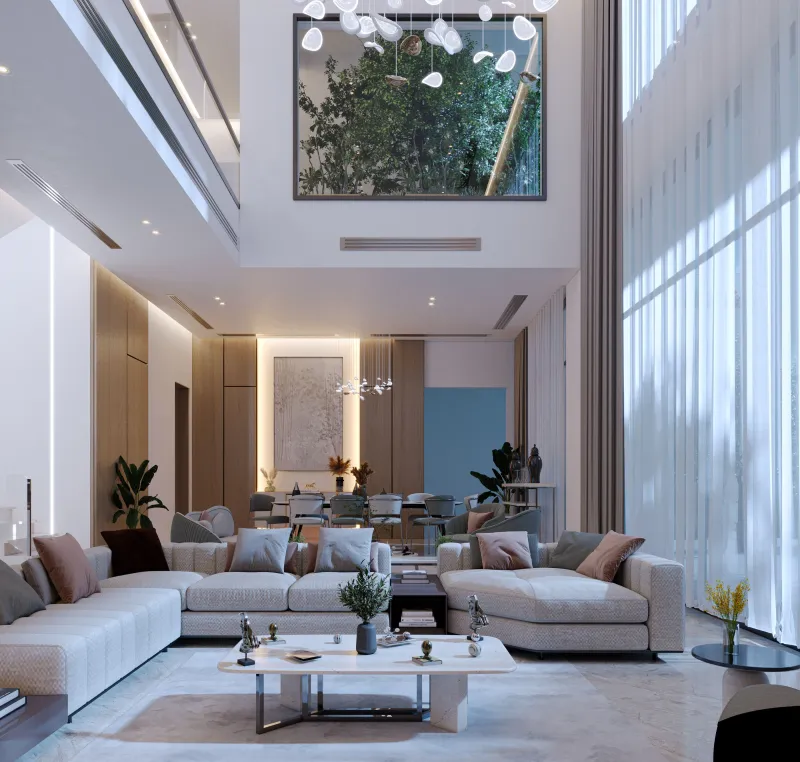
Photo: modern office living wall green plants biophilic design workplace Scotland, via kabekin.com
For much of the last decade, living walls in commercial settings were considered an aesthetic luxury — a statement piece for reception areas and boardrooms where impressions matter. That perception is shifting considerably. Across Scotland's cities, from Edinburgh's financial district to Glasgow's expanding creative quarter, a growing number of employers are approaching vertical greenery not as interior decoration, but as a deliberate investment in the psychological health of their workforce.
The distinction matters enormously. A living wall chosen purely for visual impact will be positioned, planted, and lit very differently from one designed to deliver measurable wellbeing outcomes. Understanding that difference is where meaningful biophilic design begins.
What the Evidence Actually Says
Biophilia — the innate human affinity for natural systems and living organisms — has been a subject of serious academic enquiry since the 1980s, when the American biologist Edward O. Wilson first gave the concept its formal name. Since then, research has accumulated steadily. Studies published in peer-reviewed journals including Environment and Behaviour and the Journal of Environmental Psychology consistently demonstrate that exposure to living plants in indoor environments correlates with reduced cortisol levels, lower reported anxiety, and improved attentional capacity.
One frequently cited study conducted across office environments in the United Kingdom and the Netherlands found that the introduction of plants into previously sparse workspaces increased employee productivity by approximately 15 per cent, as measured through self-reported output and task completion rates. Separately, research from the University of Exeter demonstrated that employees working in environments enriched with greenery reported significantly higher levels of satisfaction and concentration than those in lean, unplanted offices.
For Scottish employers navigating a post-pandemic landscape in which staff retention and mental health support have become strategic priorities, these findings carry practical weight.
Beyond the Potted Plant: Why Scale and Integration Matter
Not all greenery delivers equivalent psychological benefit. Workplace psychologists draw an important distinction between incidental planting — a few potted specimens placed near desks — and immersive biophilic environments where greenery is genuinely integrated into the architectural fabric of a space.
Living walls are particularly effective in the latter regard because they engage multiple senses simultaneously. The visual complexity of a well-planted vertical garden — the layering of textures, the variation in leaf size and colour, the subtle movement caused by air circulation — creates what researchers describe as 'soft fascination', a gentle, restorative engagement of the mind that contrasts sharply with the directed attention demanded by screens and deadlines. The presence of moisture from irrigation systems also contributes to measurable improvements in air humidity, which in turn reduces the incidence of dry eyes, throat irritation, and the low-grade physical discomfort that compounds occupational stress.
Dr Sarah Munro, an Edinburgh-based occupational psychologist who consults on workplace design, describes the effect in straightforward terms. "People often underestimate how much of their daily stress at work is physiological rather than purely cognitive," she explains. "When you introduce a living wall into a space, you're addressing several of those physiological stressors at once — air quality, acoustic softening, visual relief from hard surfaces. The cumulative effect on mood and focus is genuinely significant."
A Scottish Context: Case Studies in Practice
One Edinburgh legal firm undertook a substantial refurbishment of its main client-facing floor in 2022, incorporating a moss-panel installation in the central atrium alongside a hydroponic living wall in the staff breakout area. Six months after installation, an internal survey found that 71 per cent of staff reported the office environment felt less stressful than before, with the breakout area specifically cited as a space where employees felt able to decompress meaningfully during the working day.
In Glasgow, a mid-sized technology company installed a modular living wall system across a full partition wall separating its open-plan workspace from a series of meeting rooms. The installation was designed in consultation with a biophilic design specialist to prioritise species with high transpiration rates — plants that actively contribute to air moisture and particulate filtration. The company's facilities manager noted a reduction in the number of employees reporting headaches and fatigue during the winter months, a period when Scottish offices are typically sealed against the cold and indoor air quality deteriorates sharply.
These are not isolated examples. They reflect a broader shift in how Scottish businesses are interpreting their duty of care towards employees — one that increasingly encompasses the physical environment as well as HR policy.
Selecting the Right Installation for Psychological Impact
For businesses considering a living wall with wellbeing outcomes as the primary objective, several principles should guide the selection process.
Species choice is not incidental. Plants with demonstrated air-purifying properties — including certain varieties of Spathiphyllum, Chlorophytum, and Hedera — contribute to the physiological benefits that underpin psychological improvement. A purely decorative installation using drought-tolerant succulents may look striking but will deliver fewer of the environmental benefits that drive measurable wellbeing outcomes.
Position determines reach. A living wall installed in a reception area benefits clients and visitors but may have limited impact on the staff who spend eight hours a day elsewhere in the building. Installations positioned in communal areas, breakout spaces, and along frequently travelled internal routes maximise the number of employees who benefit from regular, incidental exposure.
Maintenance visibility matters. There is emerging evidence that employees derive additional psychological benefit from witnessing the care and tending of living installations — a phenomenon linked to the restorative effect of observing natural processes. A wall that appears to thrive and be actively maintained reinforces the sense that the employer values the environment and, by extension, the people within it.
Making the Investment Case Internally
For those tasked with presenting a living wall proposal to senior leadership, framing the conversation around measurable return on investment remains the most effective approach. The average cost of replacing a skilled employee in the UK — accounting for recruitment, onboarding, and lost productivity — is estimated at between 50 and 200 per cent of that individual's annual salary. Against that figure, the cost of a well-specified living wall installation appears considerably more modest.
Scotland's employers are operating in a competitive talent market, particularly in sectors such as financial services, technology, and professional services. Workspace quality has become a meaningful differentiator in recruitment conversations. A thoughtfully designed biophilic environment communicates something tangible about an organisation's values — and that communication begins the moment a prospective employee steps through the door.
The walls of a workplace have always said something about the people who work within them. Increasingly, the most progressive Scottish businesses are choosing to let those walls speak in green.