Platforms, Passengers, and Plants: The Case for Living Walls in Scotland's Rail and Transit Hubs
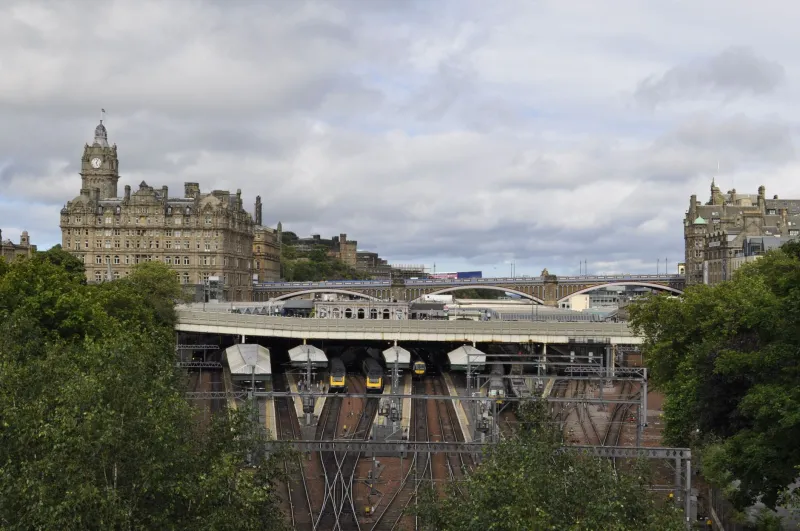
For most travellers, a railway station is a place of transience — a threshold crossed quickly on the way to somewhere else. Yet Scotland's great rail terminals, from Edinburgh Waverley's sandstone grandeur to the soaring ironwork of Glasgow Central, are also among the country's most visited public spaces. Millions of journeys begin and end within their walls each year. The question that progressive urban designers and transport planners are increasingly asking is this: what if those walls were alive?
The integration of living wall systems into transit infrastructure represents one of the more compelling frontiers in green architecture. It is also, frankly, one of the more demanding. High footfall, fluctuating humidity, diesel particulates, artificial lighting, and the relentless rhythm of arrivals and departures create an environment that tests both plant selection and engineering ingenuity. But the case for persisting with that challenge grows stronger with every year that Scotland's cities grapple with air quality targets, urban heat, and the imperative to offer visitors an arrival experience worthy of the country's reputation.
Why Transit Spaces Present a Unique Opportunity
Railway stations occupy a peculiar position in the urban fabric. They are simultaneously indoor and outdoor, public and commercial, functional and symbolic. A traveller stepping off an intercity service at Edinburgh Waverley encounters one of Britain's most architecturally distinctive termini — yet the air quality within enclosed station concourses frequently falls short of the standards we would expect in an office or retail environment. Particulate matter from braking mechanisms, accumulated vehicle emissions near taxi ranks, and the simple concentration of thousands of breathing bodies in a confined space all contribute to an air quality deficit that few passengers consciously register but many physically experience.
Living walls offer a measurable, if partial, response to this problem. Certain plant species — including ferns, peace lilies, and various mosses well-suited to Scotland's ambient humidity — are documented absorbers of volatile organic compounds and fine particulates. Deployed at scale across a station concourse or interchange atrium, a well-specified living wall system can contribute meaningfully to localised air quality improvement, particularly in spaces where mechanical ventilation is constrained by heritage building fabric.
The Engineering Challenge of the Living Commute
Installing a living wall in a residential garden or a corporate reception is a relatively controlled undertaking. A major railway station introduces variables that demand a considerably more rigorous approach to systems design.
Temperature fluctuation is perhaps the most immediate concern. Scotland's climate is characterised by relatively mild but persistently damp conditions — broadly hospitable to a range of evergreen species — but the microclimates within a busy station concourse can deviate sharply from the external environment. Heated waiting areas, draughts from frequently opened platform doors, and the thermal mass of Victorian stonework all create pockets of atypical growing conditions. Any living wall specification for a transit environment must account for this variability through robust substrate selection, redundant irrigation systems, and plant palettes chosen for resilience rather than novelty.
Lighting presents a further complication. The deeper recesses of a station concourse may receive minimal natural light, particularly during Scotland's abbreviated winter days. Supplementary grow-lighting is a well-established solution, but it introduces both an energy cost and a maintenance obligation that transport operators must factor into long-term asset management plans. The most successful transit installations tend to position living walls at points of natural light ingress — beneath glazed roof sections, adjacent to entrance canopies, or along external-facing walls — where supplementary lighting requirements are reduced and plant health is more easily sustained.
Maintenance access is equally critical. Unlike a living wall in a private courtyard, a station installation must be serviced without disrupting the continuous flow of passengers. This demands modular panel systems that permit individual sections to be removed, replaced, or replanted during off-peak hours without scaffolding or station closures. The logistical choreography of maintenance in a live transit environment is, in many respects, the most complex aspect of the entire project.
First Impressions and the Visitor Economy
Beyond the technical arguments, there is a cultural dimension to this conversation that Scotland's transport authorities would do well to consider. Rail travel is the primary mode of arrival for a significant proportion of the country's international and domestic visitors. The moment a traveller descends onto a platform at Edinburgh Waverley or emerges into the concourse at Glasgow Central is, in effect, the country's opening statement.
Comparative examples from continental Europe are instructive here. Several major European transit hubs — including installations in Amsterdam, Madrid, and Paris — have incorporated substantial vertical greenery into their public spaces, with measurable effects on passenger satisfaction scores and dwell time. Visitors who feel comfortable and engaged in a transit environment are more likely to spend time and money within the station's commercial areas, a consideration that is far from incidental to the revenue models of Scotland's rail operators.
For a country that actively promotes its landscape and natural environment as central to its identity, there is something particularly coherent about greeting arriving visitors with a living, breathing expression of that identity at the point of entry. A well-designed living wall in a Scottish railway station is not merely an amenity; it is a piece of environmental storytelling.
Sustainability Commitments and the Transport Sector
Scotland has set some of the most ambitious climate targets in the United Kingdom, and the transport sector — historically a significant contributor to national emissions — is under sustained pressure to demonstrate progress on multiple sustainability fronts. Network Rail Scotland and Transport Scotland have both articulated green infrastructure commitments in recent years, and living walls represent a credible, visible mechanism for translating those commitments into tangible public-facing action.
The biodiversity credentials of transit-based living walls also merit consideration. Installations on external station walls or beneath station canopies can provide valuable habitat for urban pollinators and nesting birds — a contribution that aligns with Scotland's biodiversity strategy and offers transport operators a meaningful entry in their environmental reporting.
A Platform Worth Building On
The integration of living walls into Scotland's rail and transit infrastructure is not a simple undertaking. It demands careful engineering, disciplined plant selection, and a long-term maintenance commitment that transport operators must be genuinely prepared to honour. Poorly maintained green installations in high-profile public spaces do considerably more reputational damage than no installation at all.
But the foundations for success are present. Scotland's climate is broadly sympathetic to the plant species best suited to transit environments. Its transport estate includes some of the most architecturally significant public buildings in Britain, many of which offer substantial wall surfaces amenable to vertical greening. And the sustainability imperative — for operators, for local authorities, and for the country as a whole — has never been more pressing.
The vertical commute, it turns out, may be the most worthwhile journey of all.