Second Life, Green Skin: Transforming Scotland's Unloved Office Parks Through Living Wall Retrofits
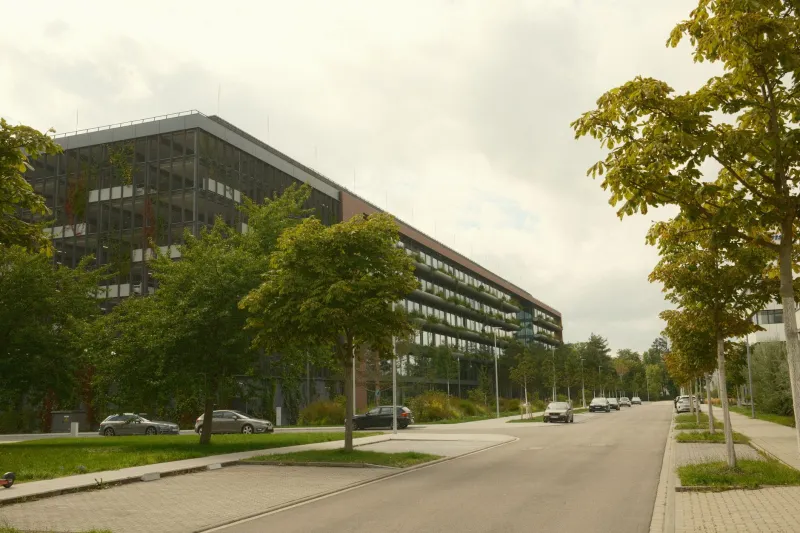
Drive past any of Scotland's established business corridors—the fringes of Edinburgh's orbital routes, the commercial clusters around Glasgow's outer ring, the light-industrial edges of Aberdeen and Dundee—and a familiar architectural vocabulary presents itself. Flat rooflines. Reflective glass panels. Exposed concrete spandrels stained by decades of Scottish rainfall. These are the office parks of the 1980s and 1990s: buildings conceived in an era of optimism about open-plan working and out-of-town commuting, now struggling to justify their existence in a market that has fundamentally shifted its expectations.
The question facing landlords, asset managers, and local authorities is no longer simply whether these buildings look tired. It is whether they remain viable at all—and, if so, by what means they might be salvaged.
Increasingly, one answer is emerging from an unexpected direction: vertical greenery.
The Problem with Scotland's Mid-Century Commercial Stock
Buildings constructed between roughly 1978 and 1998 occupy an awkward position in Scotland's commercial property landscape. They are not old enough to carry the heritage value that makes listed or category-A buildings desirable in their own right, yet neither are they modern enough to meet the energy performance standards that today's tenants—particularly those with ESG reporting obligations—increasingly demand.
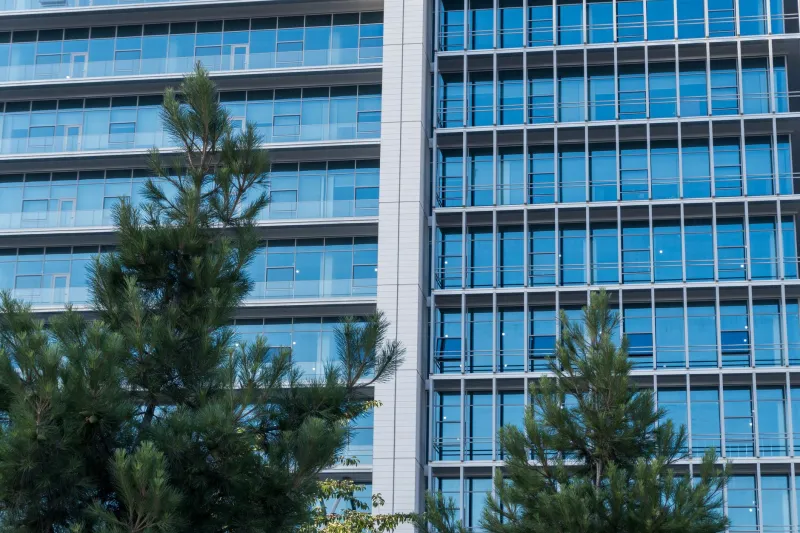
Many such buildings carry EPC ratings of D or E. Their curtain walling systems, whilst structurally sound, offer poor thermal performance by contemporary standards. Their car-heavy site layouts feel incongruous in an era of active travel and low-emission zones. And their aesthetic, frankly, repels the kind of knowledge-economy tenants who have come to expect environments that reflect their values.
Full redevelopment would address all of these issues simultaneously—but at a cost that rarely stacks up. Demolition, remediation, planning, and reconstruction of a comparable floorplate can easily reach £2,500 to £4,000 per square metre in Scottish urban locations. For assets already carrying modest yields, this arithmetic is frequently prohibitive.
Why Living Walls Are Entering the Retrofit Conversation
The proposition that a planted facade can meaningfully alter the fortunes of a struggling office park might once have seemed fanciful. It no longer does. A convergence of factors—improved system engineering, greater awareness of biophilic value, and a commercial property market that has begun pricing sustainability credentials into rental and capital values—has repositioned living walls from decorative afterthought to strategic asset.
At Scotscape Living Walls, we have observed a marked increase in enquiries from asset managers specifically seeking retrofit solutions for existing commercial buildings, rather than specifications for new developments. The motivation is rarely purely aesthetic. Landlords are weighing living walls against the full spectrum of refurbishment options and finding that, when properly specified, they offer a compelling combination of visual transformation, measurable environmental benefit, and comparatively rapid return on investment.
The Technical Realities of Retrofitting onto Curtain Walling
Retrofitting a living wall onto an existing commercial facade presents challenges that differ substantially from new-build installation. Understanding these constraints is essential to achieving a system that performs reliably over the long term in Scotland's particular climatic conditions.
Curtain walling systems—the glass and aluminium grid structures typical of 1980s and 1990s commercial buildings—were not designed to carry additional loading. Before any planting system is specified, a structural assessment of the existing facade must be commissioned. In many cases, fixings must be engineered to transfer load to the primary structural frame rather than to the curtain walling itself, which requires careful coordination between the green wall contractor and the building's structural engineer.
Water management presents a further complexity. Irrigation systems for living walls of meaningful scale require a reliable supply connection and, critically, a drainage strategy that does not compromise the existing building envelope. On older curtain wall systems, waterproofing details at the base of each panel may need remediation before a planted layer is introduced above.
Wind loading is a consideration that cannot be understated in the Scottish context. Buildings at exposed business park locations—often positioned without the shelter of surrounding urban fabric—experience significantly higher dynamic wind pressures than city-centre structures. System selection must account for this, favouring modular panel systems with robust mechanical fixings over lighter, cable-based alternatives that may be better suited to sheltered urban courtyards.
None of these challenges is insurmountable. But they do underscore the importance of engaging a specialist with genuine retrofit experience rather than treating a commercial living wall installation as a straightforward horticultural exercise.
Cost-Benefit Calculus: Green Skin Versus Full Redevelopment
The financial case for living wall retrofits on ageing commercial stock rests on several distinct value drivers, each of which carries weight in the Scottish market.
First, the capital cost differential is substantial. A well-specified external living wall system, inclusive of structural assessment, irrigation, drainage, and planting, typically ranges from £450 to £900 per square metre of planted area. Even applied across a significant elevation, this represents a fraction of the cost of full redevelopment—and it preserves the existing lettable floorplate throughout the works, avoiding the void periods that demolition and rebuild would necessitate.
Second, the impact on EPC ratings, whilst not transformative on its own, is meaningful in combination with other fabric improvements. Living walls provide an additional insulating layer that reduces heat loss through the facade, contributing incrementally to improved energy performance scores at a time when the Minimum Energy Efficiency Standards trajectory is moving firmly in the direction of higher expectations for commercial landlords.
Third—and perhaps most commercially significant—is the demonstrable effect on tenant perception and retention. Buildings that have undergone living wall retrofits in comparable UK markets have recorded measurable improvements in lease renewal rates and reductions in void periods. Tenants operating under ESG commitments are increasingly factoring the environmental credentials of their premises into occupancy decisions, and a visibly green building provides a narrative that a freshly painted concrete facade simply cannot.
Scottish Business Parks Leading the Transition
Whilst we are not in a position to identify specific clients by name without consent, the pattern of enquiry and installation we have observed across central Scotland tells a clear story. Business parks that invested in vertical greening as part of broader refurbishment programmes have consistently reported improved occupier interest within twelve to eighteen months of completion. In several instances, landlords who had been contemplating disposal of underperforming assets chose instead to retrofit and retain, subsequently achieving rental uplifts that validated the decision.
The buildings that have responded most successfully to living wall retrofits tend to share certain characteristics: elevations with sufficient uninterrupted surface area to create visual impact; access to mains water for irrigation; and landlords willing to engage with the process as a genuine asset management strategy rather than a cosmetic exercise.
A Considered Path Forward
Scotland's ageing commercial stock is not going to be replaced wholesale. The economics do not support it, and in many cases the environmental cost of demolition and rebuild would be difficult to reconcile with the sustainability commitments that now animate so much of the property sector's rhetoric.
The more productive question is how existing buildings can be made to perform better—economically, environmentally, and experientially—for the tenants, landlords, and communities they serve. Living walls will not solve every problem that a 1980s office park presents. But they offer something that full redevelopment cannot: transformation without erasure, improvement without interruption, and a visible commitment to a greener future that speaks directly to the values of the occupiers Scotland's commercial property market is working hardest to attract.
For landlords willing to look beyond the obvious, the facade is not the problem. It is the opportunity.