Borrowing Green: How Scottish Lenders Are Reassessing Living Walls as Bankable Property Improvements

For years, the financial case for living walls rested on softer arguments — improved wellbeing, brand identity, acoustic comfort. These were persuasive in boardrooms, but they rarely carried weight in the office of a mortgage underwriter. That, however, is beginning to change. Across Scotland and the wider UK, a small but growing cohort of lenders is reconsidering how installed green architecture fits within property valuation frameworks — and what that means for the borrowers who commission it.
The implications are more substantial than they might first appear. If a living wall installation can genuinely influence a property's assessed value, then it follows that it may also affect the loan-to-value ratio on a mortgage or commercial finance agreement. And where loan-to-value improves, so too can borrowing terms.
The Green Mortgage Landscape in the UK
Green mortgages — products that offer preferential rates to properties meeting certain energy efficiency thresholds — have been available in the UK since roughly 2018. Lenders including NatWest, Barclays, and several building societies have offered reduced rates to homes with an Energy Performance Certificate rating of A or B. The logic is straightforward: an energy-efficient home carries lower running costs, which in theory reduces the financial strain on the borrower and therefore the risk to the lender.
Living walls, however, occupy an interesting position within this framework. A well-designed vertical garden can contribute meaningfully to a building's thermal performance, reducing heat loss through external walls and lowering energy demand. In urban settings, living walls also contribute to reduced urban heat island effects — a factor that is increasingly relevant to climate risk assessments conducted by insurers and, by extension, lenders.
Yet living walls have not historically appeared on the checklist of qualifying improvements. The EPC methodology, which forms the backbone of most green mortgage eligibility criteria, does not currently include a standardised assessment route for vertical greenery. This is a known gap, and one that bodies including the Royal Institution of Chartered Surveyors (RICS) are actively working to address.
What Surveyors Are Actually Saying
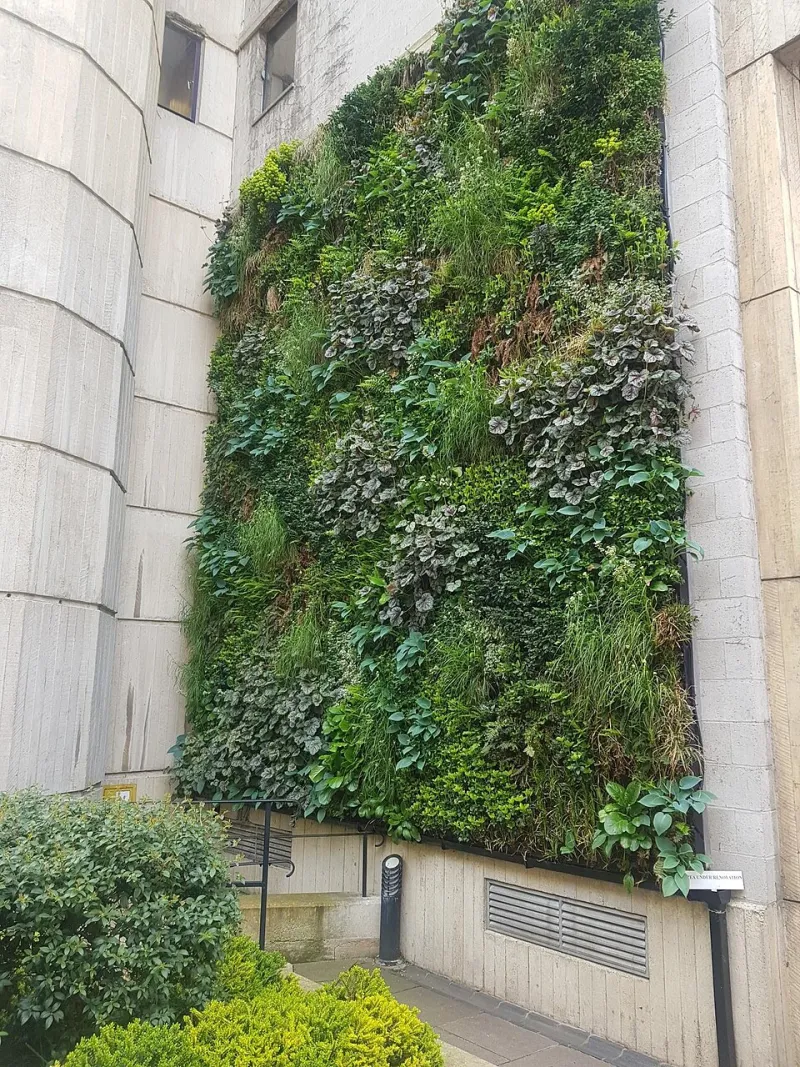
Speak to chartered surveyors operating in Scotland's commercial and residential property markets, and a nuanced picture emerges. Several practitioners note that living walls installed to a professional standard — with integrated irrigation, appropriate substrate depth, and species suited to the Scottish climate — are increasingly being noted as value-adding features rather than cosmetic additions.
"The key distinction," explains one Edinburgh-based RICS-accredited valuer, "is permanence and integration. A living wall that is structurally incorporated into the building fabric, with a documented maintenance regime, is assessed very differently from a decorative panel that could be removed without affecting the property at all."
This distinction matters enormously in practice. A living wall that demonstrably improves thermal insulation, reduces surface water run-off, or contributes to biodiversity net gain — all of which are increasingly measurable under Scottish planning and environmental frameworks — has a credible claim to being a capital improvement. One that merely looks appealing in a sales brochure does not.
Case Studies: When Green Architecture Moved the Numbers
In Glasgow's west end, the owner of a converted Victorian terrace commissioned a rear-elevation living wall as part of a broader retrofit programme. The installation, comprising native ferns, sedums, and a hydroponic modular system, was undertaken alongside cavity wall insulation and secondary glazing. When the property was subsequently remortgaged, the surveyor's valuation reflected the combined improvement package — and the resulting loan-to-value ratio allowed the owner to access a product tier that had previously been out of reach.
"The living wall wasn't assessed in isolation," the owner notes. "But it was part of what pushed the valuation above a threshold that changed my options entirely."
A more explicitly commercial example comes from a hospitality development on the outskirts of Edinburgh, where a hotel operator incorporated external living walls into a planning application partly as a biodiversity net gain measure. When the operator sought development finance for a second phase, the lender's environmental, social, and governance (ESG) assessment team flagged the existing installation positively. The borrowing terms on the second phase were marginally more favourable — a modest but real financial benefit that the operator's finance director attributes, at least in part, to the demonstrated commitment to sustainable infrastructure.
The ESG Factor in Commercial Lending
For commercial borrowers, the most immediate route through which living walls influence financing is not the mortgage market but the ESG assessment processes now embedded in corporate lending. Major UK banks have made public commitments to align their lending portfolios with net-zero targets, and this has translated into more granular scrutiny of the environmental credentials of commercial borrowers.
A business that can point to certified sustainable building features — including living walls that contribute to biodiversity, thermal performance, or stormwater management — is increasingly better positioned in these assessments. This does not guarantee a lower interest rate, but it does reduce friction in the lending process and, in some cases, unlocks access to dedicated sustainability-linked loan facilities.
Scotland's own enterprise and development finance landscape, including institutions such as the Scottish National Investment Bank, has signalled a clear preference for projects with credible environmental credentials. For developers and commercial property owners considering living wall installations, this represents a tangible financial incentive that sits entirely outside the traditional mortgage framework.
What Lenders Need to See
For homeowners and business owners hoping to leverage a living wall installation in future financing conversations, the message from property finance professionals is consistent: documentation is everything.
Lenders and surveyors need to see evidence of professional installation by a qualified contractor, a structured maintenance agreement, species selection appropriate to the local climate, and — where possible — third-party assessment of the installation's contribution to energy performance or biodiversity. In Scotland, where planning authorities in cities including Glasgow, Edinburgh, and Aberdeen are developing increasingly sophisticated green infrastructure policies, installations that align with local authority requirements carry additional credibility.
The absence of a standardised valuation methodology remains a genuine obstacle, and it is one the industry acknowledges openly. However, the direction of travel is clear. As RICS continues to develop guidance on natural capital and green infrastructure assets, and as UK lenders face increasing regulatory pressure to incorporate climate risk into their underwriting, the conditions for formal recognition of living walls within property finance are steadily converging.
A Maturing Market
The relationship between living walls and property finance is not yet mature. There is no dedicated product, no universal checklist, and no guarantee that a vertical garden will move the dial on a mortgage application. But the conversations that were simply not happening five years ago are now taking place — in surveyors' offices, in lenders' ESG teams, and in the boardrooms of Scottish developers who are beginning to see green architecture not merely as a commitment to sustainability, but as a commercially rational investment.
For those commissioning living walls today, the financial landscape they encounter in three, five, or ten years' time may look considerably more receptive than the one that currently exists. Building that case — with rigorous documentation, professional installation, and a clear understanding of what lenders actually require — is the work that begins now.